Thursday, May 15, 2008

This is It!!

I got home from Manchester yesterday to find a parcel containing this little package of digital loveliness. It's my Asus EEE900, pictured above with my horrid digits upon it, and which I have ground on about before on these pages.

The first thing that strikes you about it is just how tiny this device is compared to most lappies; it's really wee, as can be seen above. But for a little thing it does a lot. It doesn't run Windows (although it can be made to) instead preferring the free and very credible Linux operating system. And instead of Internet Explorer there's the Mozilla 'open source' Firefox. There's a music player on board, a full suite of Open Office to do your letters and presentations with and a version of the free photoshop application, the Gimp.

Added to this is the Thunderbird e-mail package which took me three minutes to get up and running with my Pop Yahoo account, as well a suite of games. There's some educational stuff on board relating to astronomy and maths, which needless to say I haven't dared boot yet.

So far so good. How does it shape as a piece of hardware? Well it ain't bad. There's a little keyboard that gives you a satisfactory typing experience once you get used to it and a little touch pad that does the mouse stuff. Reportedly this can behave like an itouch with scrolling and zooming, but not with me so far.

There's a SD card sot which I used this afternoon to upload some some pictures, including the one above, and it's fine; together with three USB 2.0 ports and an ear and mike input jack for skype-ing, or whatever. (There's a skype client already loaded. Ever had a conversation using skype? No neither have I.) A 1.3 mp web cam is fitted above the bright and friendly screen.

Battery life is a tad disappointing; it seems to be an hour and a half from full charge. When i bought a little wireless mouse for it this afternoon the chap behind the counter said he thought longer life versions would come soon. We will see.

There are no full solutions in gadget land, in as much as the 'problem' these things solve are so various, and the fast pace of technology keeps making us ask new and different things from the technology we spend time with. There's no way this is your main computer - 20 gig of storage is nowt these days, and it has no onboard optical drive. But for a little lightweight computer I'll cheerfully take on my travels and do blogging and e-mailing on this really can't be beat.

Sunday, May 11, 2008

Can You Trust the Media


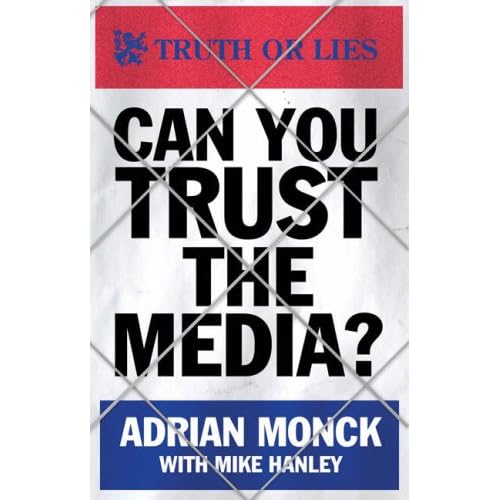
When you're a tiny hermit crab in the media rock pool it's sometimes hard to grasp the bigger debate. Why are we in this pool anyway? Why does that starfish look so different from me, a little hermit crab? How long will this pool last anyway, and is that rushing sound the tide coming in? That's why it's good to have books like Adrian Monck and Mike Hanley's 'Can We Trust the Media?'. They help you take your mind off the search for the next piece of plankton.

Back in the day Adrian was a bigger and faster fish in my pool; a producer of Special Reports for News At Ten before I did the job, then off to Five News where he was Managing Editor for some time; now he's at the City University where he lectures in journalism. I flinch to think what he teaches, because his book is no advert for our trade. Instead it is a slick exposition of everything that is wrong with the way the media operates in this country, and in one or two others.

Reading it as one who works in 'the media' I was first slightly ashamed, then appalled. Can we get anything right? It is a catalogue of venal editorial sin, ranging from a brief and effective summary of the Gilligan disaster on the 'Today' programme to the Sun's shameless nonsense about a Great White Shark off Cornwall. Hardly any horrid breach of faith is left undisturbed. Not content with the wickedness of ourselves on this side of the pond the authors even go Stateside to discuss the case of Jayson Blair, who used to make up entire stories for the New York Times. It's all deeply humbling. And in fairness Adrian doesn't spare himself; an incident in which he gave money to joyriders is related and (gleefully) so is another incident in which he stitched up the BNP live on Five News.

No academic dry text this, instead there's lots here to interest and entertain; especially if you like well informed material about how the media operates. A concise account of Silvio Berlusconi's rise to power is accompanied by a quick flashback to ancient Greece, for example. There can't be much wrong with a book which has both Plato and Piers Morgan in the index; the narrative jumps around healthily and has plenty of Zap and Pow.

But the authors' vision is of a media that pretends to be trustworthy in order to somehow cheat people of their attention, and so the book ends up as an analysis which borders on the cynical. "All news involves some form of artifice" they say. (Chapter 5, P91). The expansion of television news has simply "allowed people the convenience of opting out." (P63 in a chapter headed 'Media Bulimia'. You get the picture). It is an unremittingly negative account and if I was to take it to heart I'd never get up in the morning (or work all night, for that matter).

There's a bit missing; the portion where Adrian and his co-author could point the way ahead, to the bright shining uplands of re-establishing a better contract between media producer and consumer. In my opinion the web means that's already well on the way to being negotiated, with bloggers and comment redefining all kinds of coverage in an enormously exciting way. But that isn't here and I'm sure that's a deliberate omission; there is no way ahead in their world view, there can only be more denuding of any authority the media has and a gentle drifting away of audiences and revenue. I don't agree. I think the party's just starting.